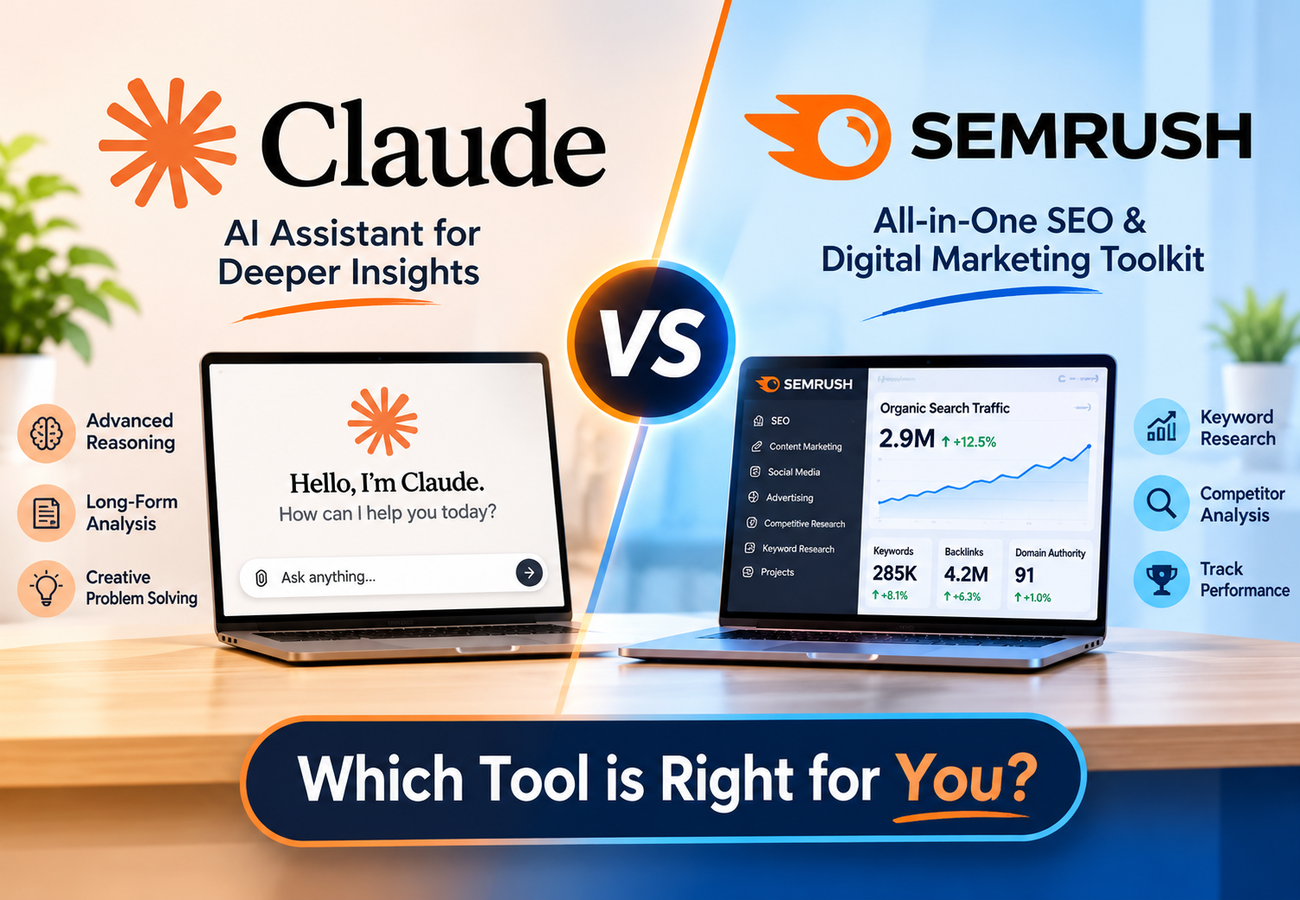
Claude vs SEMrush: Combining AI and SEO for Better Results
Here’s a question we get in nearly every first call now: “Do we still need SEMrush, or can we just ask Claude?”
Short answer, they do different jobs. Longer answer, the businesses getting the best results from their SEO services are the ones who stopped treating it as a contest. One tool knows what the market is doing. The other is very good at working out what to do about it.
Let’s take them apart honestly, because most of what’s written on this is either a vendor pitch or a panic.
What SEMrush actually gives you
SEMrush is a data business. It crawls the web, tracks keywords and sells you the results. That’s its real value, and no chatbot replicates it.
Keyword volumes and difficulty scores. Competitor domains and the terms they rank for. A backlink index. Position tracking that checks your rankings every day without anyone remembering to. Site audits that crawl your pages and flag broken links, duplicate titles and slow templates. More recently, an AI visibility toolkit that tracks whether your brand shows up in answers from tools like ChatGPT and Google’s AI Overviews.
It’s the dashboard. It tells you where you stand.
What it doesn’t do well is tell you why, or what you should do on Tuesday morning. Reviewers of its AI visibility features say the same thing: it’s good at showing gaps, lighter on explaining how to close them. You get a score and a list. Someone still has to turn that into a plan.
What Claude actually gives you
Claude is a reasoning and writing tool. Hand it material, and it reads, sorts, compares and drafts at a speed no person matches.
It has no keyword database of its own. It can’t tell you how many people in the UAE searched “AC maintenance Dubai Marina” last month, and if it ever sounds confident about that number without a tool behind it, don’t trust it. Same for backlinks, same for live rankings. Unless it’s connected to a data source, Claude is working from what you give it.
But give it something to chew on and it earns its keep. Here’s the kind of thing we mean.
Say you export a 2,000-row query report from Search Console. Claude can group those queries by intent, separate the ones where people are ready to buy from the ones where they’re browsing, flag the transliteration duplicates (Al Barsha, Albarsha, Barsha), and tell you which ten pages are quietly carrying most of your non-brand clicks. A person would need a long afternoon and a lot of coffee.
Or you paste in a competitor’s service page and your own and ask: what questions does theirs answer that mine ignores? Or you hand it 40 pages of sales call notes and ask which objections keep coming up, then turn those into FAQ answers of 40 to 60 words each. Or you need valid FAQPage and Service schema, drafted in a minute, ready for a developer to check.
None of that needs a keyword database. It needs judgement and speed.
The honest comparison
| SEMrush | Claude | |
| Keyword volumes and difficulty | Yes, its core job | No, unless connected to a data source |
| Backlink and competitor data | Yes | No |
| Daily rank tracking | Yes | No |
| Site crawling and technical audits | Yes | Reads exports; doesn’t crawl by itself |
| AI answer visibility tracking | Yes, via its AI toolkit | Can analyse your own log of prompts and answers |
| Making sense of messy data | Limited | Strong |
| Drafting briefs, FAQs, schema, meta descriptions | Basic templates | Strong |
| Explaining findings to a client in plain English | Weak | Strong |
| Knowing your brand’s voice | Only what you configure | Only what you tell it |
Read that table and the pattern is obvious. One column is about collecting facts. The other is about doing something with them.
Where combining them pays off
The workflow that works looks roughly like this.
Pull the data from SEMrush. Export your position tracking, your top competitors’ keywords, your audit issues and your AI visibility results. Add Search Console and GA4 exports, since that’s your own data and it’s more reliable than any estimate.
Give it to Claude with a real question. Not “analyse this”, which gets you a polite summary of what you already knew. Something sharper: “Which of these 300 keywords can we realistically win in six months with a site our size, and which should we ignore?” Or: “The audit flagged 140 issues. Which five do we fix first, in what order, and why?”
Let a person decide. This part isn’t optional. Claude will give you a confident, well-organised answer, and sometimes it’ll be wrong about your business in ways it couldn’t know. Someone who knows the market reads it, argues with it and overrules it where needed.
Write and ship. Claude drafts the page outline, the FAQ block, the schema. A named human with real experience puts their name on it, adds the numbers only your business has, and publishes.
Measure in SEMrush and Search Console. Back to the first step. Round we go.
In the UAE there’s an extra layer where this combination really helps. Search here mixes English and Arabic, transliteration is a mess, and demand swings with the calendar. Ramadan moves roughly eleven days earlier every year. Generic tools average that out. A person who knows the market, working with a tool that can process thousands of rows of local data quickly, doesn’t have to.
The mistakes we keep seeing
Using Claude as a keyword tool. It isn’t one. Any volume or difficulty number it gives you from memory is a guess dressed up as a fact. Take your numbers from SEMrush or Search Console.
Using SEMrush’s checklist as the strategy. A site audit that returns 140 issues has told you nothing about priority. Fixing everything in order of severity score is how teams burn a quarter on problems that never cost them a customer.
Publishing AI drafts untouched. This one hurts most. Content that contains nothing new competes badly, whoever or whatever wrote it. The drafts that work have a real number in them, a real client situation, a real opinion that could turn out wrong. That has to come from your team.
Chasing a score. Whether it’s a domain rating or an AI visibility score, it’s a proxy. The things that matter are enquiries, calls and revenue. Check them first.
An opinion that may annoy someone
For most UAE small businesses, an expensive SEMrush plan plus a stack of AI tools is overkill.
If you have a site with a few dozen pages, you can learn most of what matters from Google Search Console, Google Business Profile insights and a spreadsheet. Add a paid tool when you have a specific question the free data can’t answer, such as competitor gaps or ongoing AI visibility tracking. Buying the full suite on day one often means paying for dashboards nobody opens.
Larger sites, multi-location businesses and agencies are a different story. There, the scale of the data justifies the subscription.
What this means when you’re hiring SEO services
If you’re comparing SEO services right now, the useful question isn’t “do you use AI?” Everyone says yes. Ask instead:
Which tool answers which question, and who checks the output? Where do you deliberately not use AI? What does the monthly report lead with: rankings, or enquiries? Can you show me a recommendation that came from combining tool data with your own judgement, and what happened after?
A good team answers these quickly and specifically. A weak one gets vague and starts using the word “proprietary.”
Technical fixes can show within days of a recrawl. Content changes usually settle in two to six weeks. New pages competing for commercial terms in Dubai realistically take three to six months. No tool, however clever, shortens that by much, and anyone promising page one in thirty days is selling you something else.
The short version
SEMrush tells you what’s happening. Claude helps you work out what to do and gets the work done faster. A person who knows your customers decides what’s worth doing at all.
Use the data tool for data, the AI tool for thinking and drafting, and your own team for the things only you know. That’s the whole recipe, and it’s less exciting than most people want it to be.
Frequently asked questions
Can Claude replace SEMrush?
No. Claude has no keyword database, backlink index or daily rank tracking of its own. It’s strong at analysing, prioritising and drafting once you give it data from SEMrush, Search Console or GA4. The two work best together.
Is SEMrush worth it for a small UAE business?
Sometimes. If your site is small, Google Search Console and Google Business Profile insights cover most needs for free. SEMrush becomes worth the cost when you need competitor data, ongoing rank tracking or AI visibility monitoring at scale.
How can AI improve SEO services?
It speeds up the slow parts: clustering search queries, summarising competitor pages, drafting briefs, FAQs and schema, and turning audit exports into a prioritised to-do list. Strategy, fact-checking and anything customer-facing still need a person.
Can AI tools track whether ChatGPT mentions my business?
Dedicated tools, including SEMrush’s AI visibility features, track brand mentions across AI answers. You can also do it manually: run 20 to 30 real customer questions through each assistant monthly, record which sources get cited, and let Claude help you analyse the log.
Should I publish content written by AI?
Only after a person has added what the AI can’t: your own numbers, real client examples, a named author and a position you’d defend. Generic output performs poorly because it says nothing new, not because a model wrote it.
What should I look for in SEO services in Dubai?
A clear explanation of which tools do which job, reporting that leads with enquiries rather than rankings, proper handling of Arabic and English search, and a named person responsible for the work.
How long does it take to see results from combining AI and SEO?
Faster production, usually within weeks. Rankings take longer: two to six weeks for on-page changes to settle, and three to six months for new pages competing on commercial terms.
Mind Digital uses a mix of data platforms, AI tools and experienced people to run search programmes for UAE brands including Pfizer, Adidas, Tommy Hilfiger, Landmark Group and Virgin Megastore from our DMCC office. If you’d like to see what your own data says before you commit to anything, look at our SEO services or get in touch.
Related Posts



Follow us
Recent post
Popular post
- How To Call Batch Apex By Scheduler Class Within Salesforce
- What Is The Importance Of Google Algorithm Updates
- How To Create Dynamic Dependent Picklist Of Objects Within Salesforce
- What Is Wrapper Class & How To Use It In Salesforce
- How To Create Pagination Within Salesforce
- Tips For Hiring A Good Offshore Drupal Development Company
- Web Development Mistakes That Affect Your Online Reputation
- How To Integrate Google Maps Into Your Salesforce Software
- Check Your Link Building Strategy For 2014
- Tips For Selling Products Through Social Networking
- How To Create A Chart With Salesforce
- Benefits of Using India For Outsourcing & Offshore Development
- How To Integrate Salesforce With Facebook
- What Is Service Cloud Console In Salesforce & How To Enable It
- Superior Offshore Web Development At A Reasonable Cost
- How To Create Bucket Fields In Your Salesforce Reports
- 5 Things To Consider When Hiring A Drupal Developer
- Growth Of E-commerce Website Development
- Challenges In Hiring An Offshore Web Development Company
- 10 Tips When Creating Batch Apex In Salesforce
- What To Include & What To Exclude In SEO Plans
- How To Create An Opportunity Using A Visualforce Page In Salesforce
- Hire An Offshore Ruby On Rails Development Company Over A Freelancer
- Hire Drupal Developers Offshore To Increase Your Capabilities
- Effective SEO In A Post Panda Update – The Rules Have Changed
- Common Mistakes In Offshore Web Development
- What To Consider While Hiring A Dedicated Ruby On Rails Developer?
- Smart Phone & Tablet User Penetration
- Tips For Hiring A Good Offshore PHP Development Company
- Why Responsive Web Design Is Essential For Your Business
- How To Email Documents From Salesforce
- Website Development And Website Design Company India
- Why Work With An Offshore Development Company?
- How To Create Tab Panel In Salesforce
- How To Avoid 5 Common Off-Page SEO Mistakes
- The Multi-Billion Dollar Offshore Software Development Industry
- What Are The Advantages Of Digital Marketing Over Traditional Marketing?
- SEO & Conversational Keyword Search
- How To Avoid 5 Common On-Page SEO Mistakes
- How To Add Google Authorship And Its Benefits For Better SEO
- What’s Better For Facebook Ads: CPC Or CPM?
- Questions To Ask Your Potential Search Engine Optimization Partner
- How To Create Batch Apex In Salesforce
- Benefits Of Offshore PHP Development For Your Businesses
- Offshore Magento Development Means More Than Just Development Help
- Why You Should Consider Hiring Joomla Developers Offshore
- What To Look For When Hiring A Dedicated OpenCart Developer
- Stop Using Free Web Templates – Hire A Web Development Company
- How To Manage An Offshore Development Company?
- Hire Offshore Software Professionals To Help Your Business
- Offshore Development Is A Sensible Solution For Recessionary Times
- Why You Should Offshore Your Joomla Website Development
- 5 Tips To Help You Hire A Good Offshore PHP Development Company
- Reasons Why Salesforce CRM Customization Is Easy
- PHP Development – Turn Your Website Into A Multi-Featured Web Application
- 5 Things To Ask A Web Development Company Before Starting Work
- How A Multifaceted Web Development Company Can Help You?
- Take Advantage By Hiring A PHP Development Company From India
- Use Social Media Marketing To Improve Your Brand Identity
- Hiring Dedicated Developers From Offshore Development Companies
- See Measurable Results By Hiring Dedicated Ruby On Rails Developer
- Avoid 4 Common WordPress Development Mistakes
- Can “Developed By” Links Hurt Your SEO?
- How To Get All Salesforce Components In Force.com IDE
- The Manifold Advantages Of Working With An Offshore Web Development Company
- Web Development Company In India Defined
- Hire A Dedicated Drupal Developer To Develop A High Performance CMS
- Offshore Development – The Most Beneficial And Cost Effective Way To Outsource Your Business
- What To Look For When Hiring An Offshore Development Company
- Why Dedicated PHP Web Developers Are In Demand
- How To Avoid Some Common Mistakes When Working With An Offshore Web Development Company
- How To Choose An SEO Company
- Factors To Consider When Hiring Offshore Developers In India
- What To Look For When Hiring Dedicated Magento Developers
- Why Google Create Its Own Title Instead Of Using Yours
- 3 Challenges of Working with an Offshore Web Development Company
- Why Ruby On Rails Development Has Become Popular
- Why Hire A Web Development Company That Also Offers SEO
- 10 Tips And Tricks For Salesforce
- Are Back-links Losing Their Importance To Google Search Rankings
- The Significance Of A Salesforce Developer
- 4 Reasons to Hire A Web Development Agency Over A Freelancer
- Hire A PHP Developer- How Outsourcing Can Be A Key To Success
- Importance Of Strategic Digital Marketing For Business Growth
- Factors To Keep In Mind Before Hiring Dedicated Magento Developer
- Web Development India – For Prompt And Accurate Services
- Looking For An Offshore PHP Development Company, Where Do I Begin?
- 5 SEO Myths
- How To Choose A Company When Hiring Dedicated PHP Developers
- Why You Should Optimize For Local Search
- Hiring Offshore WordPress Developers Can Help Your Business
- How To Use Social Networking To Market Your Business
- Why Offshore Web Development To India Makes Business Sense
- 5 Factors To Consider When Hiring A Web Development Company
- Top Five Benefits Of Salesforce
- Benefits Of Hiring A Dedicated PHP Developer From India
- Using SEO & Social Media Together
- How Can An SEO Company Help Your Profile Online
- Strategic Importance Of Mobile SEO
- Choose The Social Media Network That Suits Your Business
Archives
- November 2026
- October 2026
- September 2026
- August 2026
- July 2026
- June 2026
- May 2026
- April 2026
- March 2026
- February 2026
- January 2026
- December 2025
- November 2025
- October 2025
- September 2025
- August 2025
- July 2025
- June 2025
- May 2025
- April 2025
- March 2025
- February 2025
- January 2025
- December 2024
- November 2024
- October 2024
- September 2024
- July 2024
- June 2024
- May 2024
- April 2024
- March 2024
- February 2024
- September 2023
- August 2023
- July 2023
- June 2022
- May 2022
- March 2022
- January 2022
- August 2021
- July 2021
- June 2021
- May 2021
- January 2021
- December 2020
- September 2020
- August 2020
- July 2020
- June 2020
- April 2020
- March 2020
- December 2019
- November 2019
- October 2019
- September 2019
- August 2019
- July 2019
- June 2019
- May 2019
- April 2019
- March 2019
- February 2019
- January 2019
- December 2018
- November 2018
- September 2018
- April 2018
- February 2018
- January 2018
- September 2017
- August 2017
- July 2017
- June 2017
- May 2017
- April 2017
- March 2017
- February 2017
- January 2017
- December 2016
- November 2016
- October 2016
- September 2016
- August 2016
- July 2016
- June 2016
- May 2016
- April 2016
- March 2016
- February 2016
- January 2016
- December 2015
- November 2015
- October 2015
- September 2015
- August 2015