
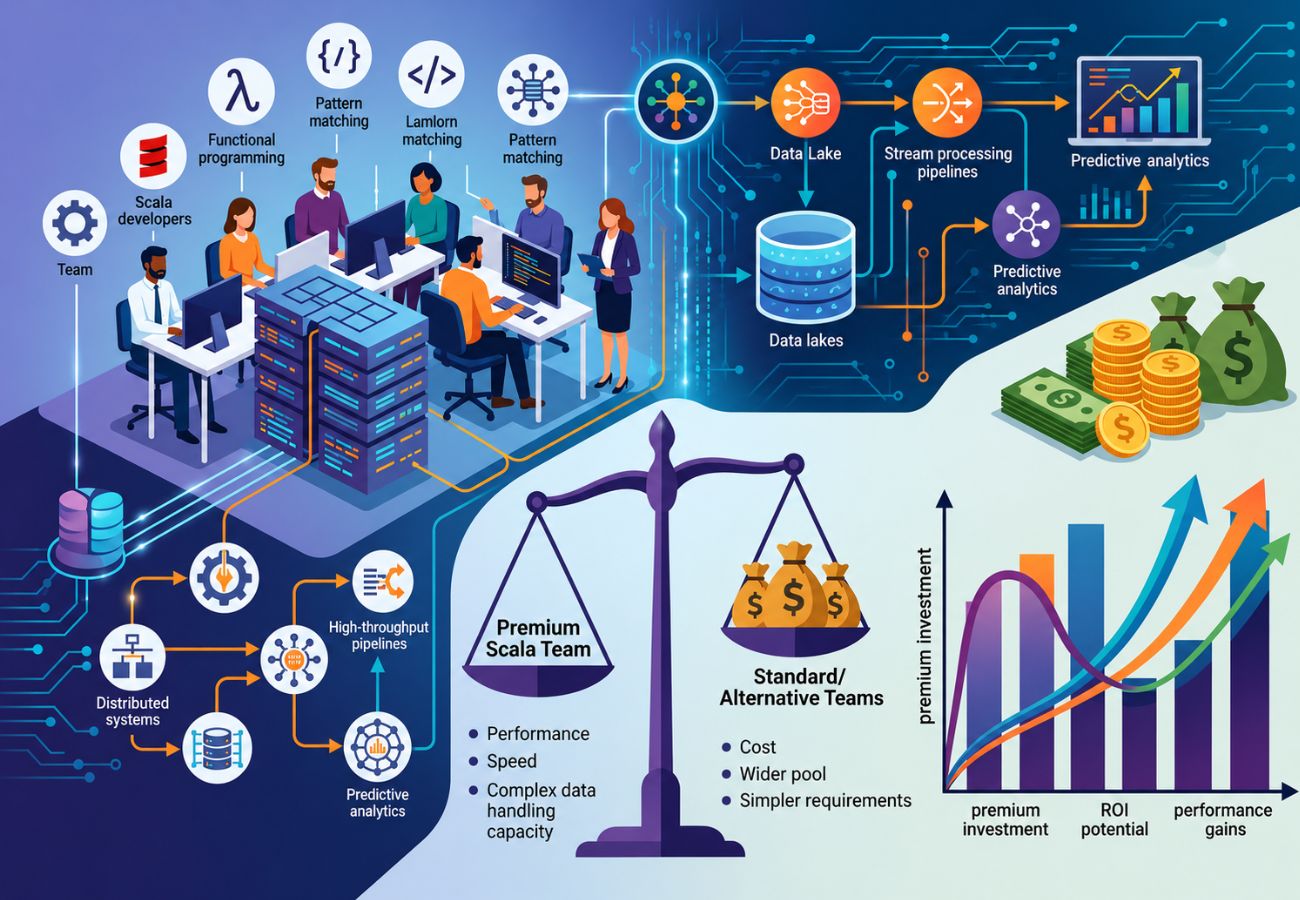
Is a Dedicated Scala Team Worth the Premium for a Data-Heavy Product?
There is a simple answer that many software consultancies avoid giving: most companies do not need a dedicated Scala team.
If your product is a CRM, an internal workflow tool, or a standard SaaS platform, the additional hiring costs will probably never pay for themselves. A good Java, Go, or Python team can handle the workload perfectly well.
The discussion changes when data processing stops being a feature and becomes the business itself.
Recommendation engines, fraud detection systems, real-time logistics platforms, advertising technology, and financial analytics products all have one thing in common. Their value comes from moving, transforming, and analyzing enormous amounts of information. For companies building that kind of software, hiring dedicated Scala engineers is often a business decision rather than a technology preference.
The premium exists. The question is whether it buys something meaningful.
Apache Spark gave Scala a very practical advantage
Scala was never designed exclusively for big data, but Apache Spark permanently changed how the language is viewed across the industry.
Although PySpark has become extremely popular, Spark itself was written in Scala. The underlying APIs, execution model, and many advanced optimization techniques still reflect that origin. Engineering organizations at companies like Netflix, LinkedIn, Airbnb, and Uber have used Spark extensively because processing billions of events with traditional approaches simply does not scale.
That does not mean every Spark project should be written in Scala.
In fact, many successful teams rely heavily on Python because it is easier to hire for and integrates naturally with machine learning workflows. If most of the work involves experimentation and analytics, PySpark may be the better choice.
The tradeoff appears later, when prototypes become production systems.
Building a Spark pipeline is easy. Living with it is harder.
Many engineering managers assume that experienced backend developers can simply learn Scala if the project requires it.
Usually, they can.
The bigger challenge is understanding distributed computing well enough to avoid expensive mistakes.
A Spark job that performs well against a development dataset may behave very differently once it starts processing hundreds of gigabytes or several terabytes. Joins become expensive. Shuffle operations explode. Memory pressure grows. Cloud bills quietly increase month after month.
The frustrating part is that these problems rarely break the system.
They just make it progressively more expensive to operate.
Ask engineers who have inherited a five-year-old Spark platform what causes the most trouble, and the answer usually is not Scala itself. It is the collection of undocumented decisions that accumulated over time. Somebody repartitioned the data to address a performance issue. Another engineer introduced aggressive caching six months later. Eventually, nobody remembers why either change was made.
That kind of institutional knowledge is difficult to rebuild after the original team moves on.
Looking only at Scala engineer cost misses the bigger expense
Scala specialists generally cost more than developers working with mainstream backend stacks.
The talent pool is smaller, and many experienced candidates have backgrounds in distributed systems, streaming platforms, or large-scale data engineering. The average Scala engineer cost reflects that scarcity.
At the same time, companies often overestimate how much they actually need that expertise.
A surprising number of startups invest in sophisticated JVM-based data platforms when a relational database and a few scheduled Python jobs could support growth for several more years.
Hiring specialists before the business requires them is just as wasteful as hiring them too late.
But once data volume reaches the point where infrastructure spending becomes a major operating expense, the calculation changes.
Imagine a nightly processing pipeline that runs for four hours across dozens of cloud instances. If an experienced team cuts that execution time in half, the savings continue every single day. Over the product’s lifetime, reduced infrastructure costs may easily offset the additional hiring budget.
That is why companies building large data-intensive applications often evaluate engineering investments differently than traditional software businesses.
Spark optimization is a skill that takes time to develop
Many résumés include Apache Spark.
Far fewer engineers have spent years optimizing production workloads.
Writing code that runs is only the starting point. Experienced Scala developers spend much of their time reading execution plans, reducing unnecessary data movement, minimizing serialization overhead, and deciding whether caching actually improves performance or simply consumes memory.
Most users never think about any of this.
They notice that yesterday’s sales report is available before the morning meeting. They notice that recommendations load immediately instead of several seconds later. They notice that dashboards refresh without delays.
Behind those small experiences is a long series of engineering decisions that most customers will never see.
Efficient Spark data processing usually looks boring from the outside.
That is often a sign that the underlying architecture is doing its job.
Sometimes, a dedicated development team is the cheaper option
This sounds backward, but maintaining a specialized, dedicated development team can cost less than relying on a rotating group of generalists.
Distributed systems accumulate history. Design choices made three years ago continue affecting performance today. Teams that stay together understand those decisions because they lived through them.
Contractors or newly assembled internal groups often spend months rediscovering old problems before they can improve anything.
There is another side to this argument, though.
If large-scale data processing supports only a small part of the product, maintaining a dedicated Scala group may create unnecessary overhead. Specialists need challenging work to stay productive. Otherwise, expensive talent ends up handling routine backend tasks.
The right answer depends on whether the platform itself creates business value or simply supports it.
Growth creates technical problems that money alone cannot solve
Many startups believe scaling means adding more servers and more developers.
The first part is relatively easy.
The second is more complicated.
As engineering organizations grow, different developers bring different habits, coding styles, and assumptions about performance. A distributed platform originally designed by three people can slowly evolve into a collection of competing patterns.
Successful team scaling is often less about hiring faster and more about preserving consistency.
Stable Scala teams tend to establish conventions around data modeling, testing, deployment, and performance tuning. New engineers inherit those standards instead of introducing entirely new approaches.
That matters when the product reaches a size where architectural mistakes become expensive to reverse.
The real engineering ROI often appears outside the roadmap
Feature velocity is easy to measure.
Operational efficiency is not.
Reducing cloud costs by 20 percent rarely gets the same attention as launching a new customer-facing capability, even though the financial impact may be larger. Preventing outages does not create a press release. Avoiding a complete platform rewrite usually goes unnoticed because nothing dramatic happened.
That broader picture is where engineering ROI becomes useful.
A specialized Scala team may not ship more features than a general backend group. In some cases, they may even move more slowly because optimization work takes time.
What they often produce instead is a platform that remains manageable as data volumes continue growing.
That does not make a dedicated Scala team the right answer for every company.
But if your business depends on processing massive datasets every hour of every day, hiring specialists can be easier to justify than expanding infrastructure every quarter.
For many data-heavy products, that is the real comparison.
Related Posts



Follow us
Recent post
Popular post
- How To Call Batch Apex By Scheduler Class Within Salesforce
- What Is The Importance Of Google Algorithm Updates
- How To Create Dynamic Dependent Picklist Of Objects Within Salesforce
- What Is Wrapper Class & How To Use It In Salesforce
- How To Create Pagination Within Salesforce
- Tips For Hiring A Good Offshore Drupal Development Company
- Web Development Mistakes That Affect Your Online Reputation
- How To Integrate Google Maps Into Your Salesforce Software
- Check Your Link Building Strategy For 2014
- Tips For Selling Products Through Social Networking
- How To Create A Chart With Salesforce
- Benefits of Using India For Outsourcing & Offshore Development
- How To Integrate Salesforce With Facebook
- What Is Service Cloud Console In Salesforce & How To Enable It
- Superior Offshore Web Development At A Reasonable Cost
- How To Create Bucket Fields In Your Salesforce Reports
- 5 Things To Consider When Hiring A Drupal Developer
- Growth Of E-commerce Website Development
- Challenges In Hiring An Offshore Web Development Company
- 10 Tips When Creating Batch Apex In Salesforce
- What To Include & What To Exclude In SEO Plans
- How To Create An Opportunity Using A Visualforce Page In Salesforce
- Hire An Offshore Ruby On Rails Development Company Over A Freelancer
- Hire Drupal Developers Offshore To Increase Your Capabilities
- Effective SEO In A Post Panda Update – The Rules Have Changed
- Common Mistakes In Offshore Web Development
- What To Consider While Hiring A Dedicated Ruby On Rails Developer?
- Smart Phone & Tablet User Penetration
- Tips For Hiring A Good Offshore PHP Development Company
- Why Responsive Web Design Is Essential For Your Business
- How To Email Documents From Salesforce
- Website Development And Website Design Company India
- Why Work With An Offshore Development Company?
- How To Create Tab Panel In Salesforce
- How To Avoid 5 Common Off-Page SEO Mistakes
- The Multi-Billion Dollar Offshore Software Development Industry
- What Are The Advantages Of Digital Marketing Over Traditional Marketing?
- SEO & Conversational Keyword Search
- How To Avoid 5 Common On-Page SEO Mistakes
- How To Add Google Authorship And Its Benefits For Better SEO
- What’s Better For Facebook Ads: CPC Or CPM?
- Questions To Ask Your Potential Search Engine Optimization Partner
- How To Create Batch Apex In Salesforce
- Benefits Of Offshore PHP Development For Your Businesses
- Offshore Magento Development Means More Than Just Development Help
- Why You Should Consider Hiring Joomla Developers Offshore
- What To Look For When Hiring A Dedicated OpenCart Developer
- Stop Using Free Web Templates – Hire A Web Development Company
- How To Manage An Offshore Development Company?
- Hire Offshore Software Professionals To Help Your Business
- Offshore Development Is A Sensible Solution For Recessionary Times
- Why You Should Offshore Your Joomla Website Development
- 5 Tips To Help You Hire A Good Offshore PHP Development Company
- Reasons Why Salesforce CRM Customization Is Easy
- PHP Development – Turn Your Website Into A Multi-Featured Web Application
- 5 Things To Ask A Web Development Company Before Starting Work
- How A Multifaceted Web Development Company Can Help You?
- Take Advantage By Hiring A PHP Development Company From India
- Use Social Media Marketing To Improve Your Brand Identity
- Hiring Dedicated Developers From Offshore Development Companies
- See Measurable Results By Hiring Dedicated Ruby On Rails Developer
- Avoid 4 Common WordPress Development Mistakes
- Can “Developed By” Links Hurt Your SEO?
- How To Get All Salesforce Components In Force.com IDE
- The Manifold Advantages Of Working With An Offshore Web Development Company
- Web Development Company In India Defined
- Hire A Dedicated Drupal Developer To Develop A High Performance CMS
- Offshore Development – The Most Beneficial And Cost Effective Way To Outsource Your Business
- What To Look For When Hiring An Offshore Development Company
- Why Dedicated PHP Web Developers Are In Demand
- How To Avoid Some Common Mistakes When Working With An Offshore Web Development Company
- How To Choose An SEO Company
- Factors To Consider When Hiring Offshore Developers In India
- What To Look For When Hiring Dedicated Magento Developers
- Why Google Create Its Own Title Instead Of Using Yours
- 3 Challenges of Working with an Offshore Web Development Company
- Why Ruby On Rails Development Has Become Popular
- Why Hire A Web Development Company That Also Offers SEO
- 10 Tips And Tricks For Salesforce
- Are Back-links Losing Their Importance To Google Search Rankings
- The Significance Of A Salesforce Developer
- 4 Reasons to Hire A Web Development Agency Over A Freelancer
- Hire A PHP Developer- How Outsourcing Can Be A Key To Success
- Importance Of Strategic Digital Marketing For Business Growth
- Factors To Keep In Mind Before Hiring Dedicated Magento Developer
- Web Development India – For Prompt And Accurate Services
- Looking For An Offshore PHP Development Company, Where Do I Begin?
- 5 SEO Myths
- How To Choose A Company When Hiring Dedicated PHP Developers
- Why You Should Optimize For Local Search
- Hiring Offshore WordPress Developers Can Help Your Business
- How To Use Social Networking To Market Your Business
- Why Offshore Web Development To India Makes Business Sense
- 5 Factors To Consider When Hiring A Web Development Company
- Top Five Benefits Of Salesforce
- Benefits Of Hiring A Dedicated PHP Developer From India
- Using SEO & Social Media Together
- How Can An SEO Company Help Your Profile Online
- Strategic Importance Of Mobile SEO
- Choose The Social Media Network That Suits Your Business
Archives
- June 2026
- May 2026
- April 2026
- March 2026
- February 2026
- January 2026
- December 2025
- November 2025
- October 2025
- September 2025
- August 2025
- July 2025
- June 2025
- May 2025
- April 2025
- March 2025
- February 2025
- January 2025
- December 2024
- November 2024
- October 2024
- September 2024
- July 2024
- June 2024
- May 2024
- April 2024
- March 2024
- February 2024
- September 2023
- August 2023
- July 2023
- June 2022
- May 2022
- March 2022
- January 2022
- August 2021
- July 2021
- June 2021
- May 2021
- January 2021
- December 2020
- September 2020
- August 2020
- July 2020
- June 2020
- April 2020
- March 2020
- December 2019
- November 2019
- October 2019
- September 2019
- August 2019
- July 2019
- June 2019
- May 2019
- April 2019
- March 2019
- February 2019
- January 2019
- December 2018
- November 2018
- September 2018
- April 2018
- February 2018
- January 2018
- September 2017
- August 2017
- July 2017
- June 2017
- May 2017
- April 2017
- March 2017
- February 2017
- January 2017
- December 2016
- November 2016
- October 2016
- September 2016
- August 2016
- July 2016
- June 2016
- May 2016
- April 2016
- March 2016
- February 2016
- January 2016
- December 2015
- November 2015
- October 2015
- September 2015
- August 2015
- July 2015
- June 2015
- May 2015
- April 2015
- March 2015